
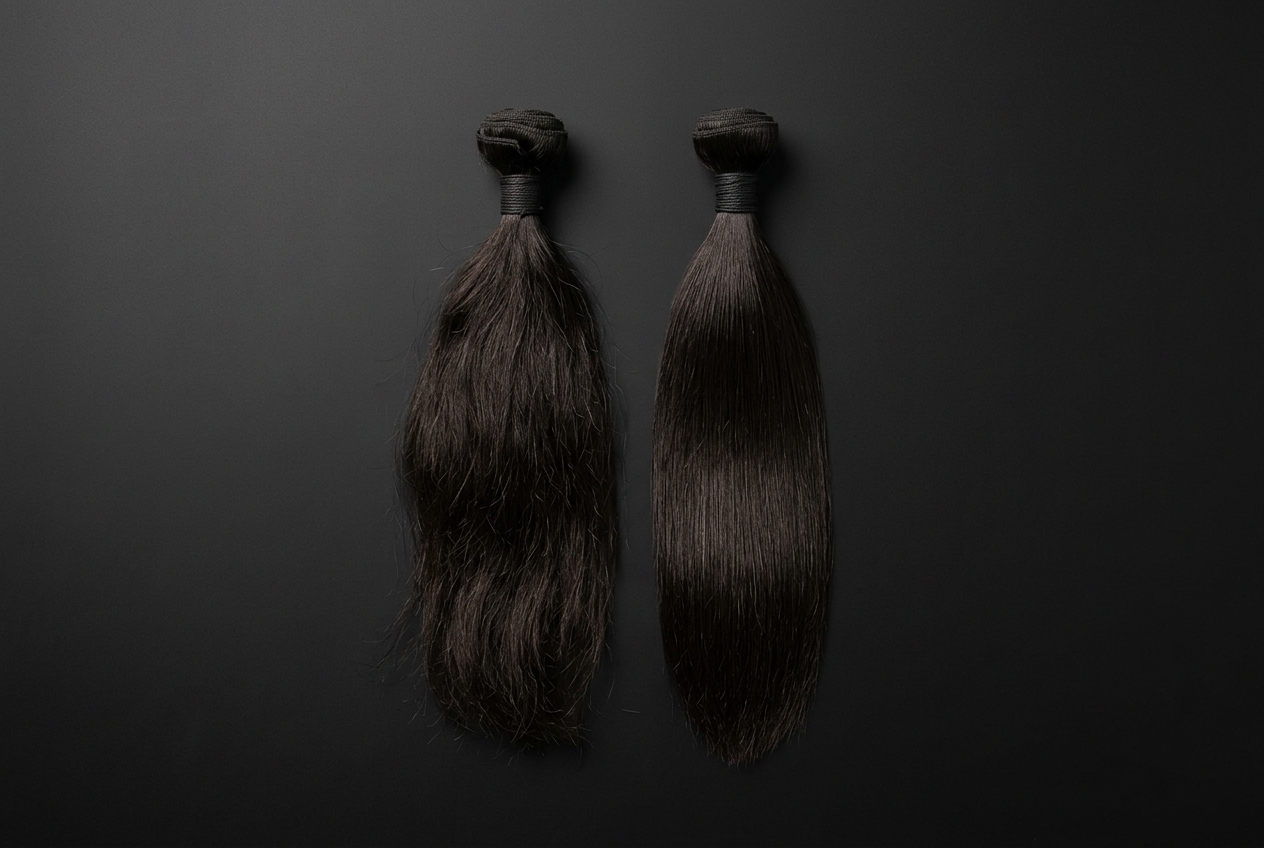
Raw Hair vs Virgin Hair: What Buyers Need to Know Before Ordering
Raw hair and virgin hair appear in virtually every professional hair listing. But neither term is regulated by a universal standard — and the definitions vary significantly between suppliers and markets. This article explains the typical distinctions and how to evaluate beyond the label.
"Raw hair" and "virgin hair" appear on virtually every professional hair listing. The terms are not interchangeable, and neither is regulated by a universal standard. Understanding what each typically means — and where the definitions vary — helps buyers evaluate products on measurable characteristics rather than marketing positioning.
Two Terms, Overlapping but Different
Virgin hair is the longer-established and more widely used term. It is generally understood to mean hair that has not been chemically processed by the supplier — no dyes, bleach, perms, or relaxers. The cuticle layer is typically present, though cuticle orientation is not always addressed by the term alone.
Raw hair is a more recent classification that some suppliers use for products they describe as minimally processed, often associated with characteristics such as direct collection from individual donors, no post-collection chemical treatment, and intact cuticle scales. Some suppliers use "raw" for products that have not been processed by an intermediary, while others use it specifically to describe single-donor hair.
The distinction between these two terms is not standardised. Some suppliers in certain markets use "raw virgin" as a combined term. In other contexts, "raw" is used to describe unprocessed bulk hair as opposed to a manufactured weft product. The same label can mean different things from different suppliers, and a price difference between products labelled raw and virgin does not by itself indicate which is actually superior for a given application.
What "Unprocessed" May and May Not Imply
When a supplier says their hair is "unprocessed," this most commonly means that the supplier or their processing facility has not applied chemical treatment. It does not always address:
• Whether the donor's hair had been chemically treated before collection • Whether any post-collection physical or heat processing was applied (steaming, mechanical straightening) • Whether any surface treatment, coating, or conditioner was applied after collection • Whether cuticle scales are aligned or randomly oriented within the product
Each of these has practical implications for product performance. Ask for specifics rather than assuming the label answers these questions.
Cuticle Orientation
Cuticle orientation — whether the cuticle scales on all strands run in the same root-to-tip direction — is often cited as a distinguishing feature of premium raw or virgin products.
Hair with consistently oriented cuticles may have different detangling behaviour compared to hair with mixed cuticle directions. Running fingers along strands from root to tip and then tip to root can provide a practical indication — but it is not a definitive technical measurement of cuticle alignment, and other factors affect how the test feels.
Surface treatments such as coatings or conditioners can mask cuticle characteristics during initial assessment. Washing a small section and reassessing may be informative, but it cannot identify the specific treatment used.
Comparing by Specification, Not Label
The most effective approach to comparing raw and virgin hair offers from different suppliers is to focus on measurable product specifications rather than label terminology:
• What chemical processing has occurred, if any? • What post-collection processing has been applied (heat, mechanical, coating)? • What is the natural colour, texture and origin of the hair? • What documentation or traceability information can the supplier provide? • What is the cuticle orientation characteristic of this product? • Has a sample been evaluated?
Remy, Raw, and Virgin — Without a Hierarchy
A brief note on a third term buyers will encounter: Remy hair. Remy refers specifically to cuticle-aligned hair where the cuticle scales run in the same direction — it is a construction or alignment description, and can apply to hair that has been collected, processed, and assembled with that characteristic maintained. Remy hair may or may not be "virgin" depending on whether it has been chemically processed.
These three terms are sometimes positioned as a universal quality ladder (raw > virgin > remy), but this presentation oversimplifies the market. A well-processed remy product may perform better for a specific end-use than a poorly sourced product labelled raw. The label is a starting point; the specification and sample evaluation are the substance.
Questions to Ask
Before placing an order:
• What does "raw" / "virgin" specifically mean in your production process? • What processing — chemical, heat, coating, or other — has occurred after collection? • What sourcing or traceability information can you provide? • Are the cuticle scales consistently oriented throughout this product? • Can you provide a sample before a bulk order? • Can you confirm the above in writing as part of the purchase specification?